BrainXchange

Creative Solutions to help HR Managers and Internal Communications Managers engage and connect with employees
BrainXchange
  • Our Purpose
  • About
  • Contact
  • Author Archives: Bill Shirk

    • Why employee engagement is crucial to a company’s success?

      Posted at 3:08 pm by Bill Shirk, on April 5, 2017

      Why Employee engagement is crucial

      So why is employee engagement such a key factor in the prosperity of a business? Businesses where the employees are engaged outperform those that don’t. For example, companies with engaged employees are:
      More profitable
      Have better customer ratings
      Higher productivity
      Better quality
      Less turnover
      Less absenteeism
      Fewer mistakes
      Fewer safety incidents
      More organized
      Higher shareholder returns
      Have trust in company leadership
      Invest in communications to their workforce

      Do you have any idea of how many workers are disengaged at businesses around the world? Depending on which research or study you read, you’ll find numbers as high as 70 percent. These employees are considered as not engaged or actively disengaged at work.

      What causes low employee disengagement?

      Disengaged employees are:
      Doing the wrong job or in the wrong role
      Feel that their job isn’t import to the company
      Don’t think that they are making meaningful contributions to the company
      Don’t feel that they are valued, recognized or rewarded for their job
      Don’t understand the company’s mission or values
      Do not trust leadership
      Receiving poor internal communications from leadership and management

      It’s obvious that more business leaders need to consider employee engagement as the number one objective for their company’s success.

      The best business leaders make it a priority to engage their employees through various communications channels. They are committed to incorporating communications as a strategic business decision to reinforce and recognize the importance of employee engagement.

      After all, if employees are a company’s biggest assets, then communications has to be the most important tool for leaders to increase employee engagement.

      Bill Shirk is a principle at Think Tank and specializes in creating customized communications solutions that engage, educate, and energize employees. Want to learn more about how employee engagement and communications can impact your company? Reach out to us.

      Share this: Share

      • Click to share on X (Opens in new window) X
      • Click to share on Facebook (Opens in new window) Facebook
      • Click to share on LinkedIn (Opens in new window) LinkedIn
      Like Loading...
      Posted in Uncategorized | 0 Comments
    • 3 tips to help your internal communications connect and engage with the multi-generational workforce.

      Posted at 10:41 am by Bill Shirk, on January 9, 2017

      multi_generational-group

      The dynamics of today’s workforce are changing. The Boomer generation is delaying retirement and more Gen Xers are moving into leadership roles.

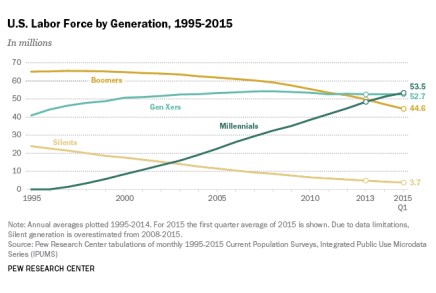
      genlaborforcecomposition1And, have you noticed that there are more and more articles about Millennials in the workforce? With more older generation workers retiring each year, mainly the Silents, Millennials now make up more than one-third of today’s workforce.
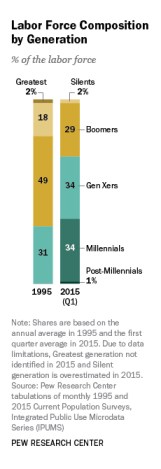
      Millennials have surpassed Gen Xers as the largest generation in the labor force.

      According to Pew Research, more than one-in-three American workers today are Millennials (adults ages 18 to 34). This milestone happened in the first quarter of 2015 when Millennials surpassed Generation X to become the largest share of the American workforce or more than 53.5 million. The Millennial workforce had already surpassed the Boomers in 2014.

      genlaborforcecompositionstacked11. Create a communications plan for the multi-generational workforce.

      With such a diverse workforce, there is no one-size-fits-all method for an internal communications plan. The most effective solution is to develop a plan that includes multiple communication channels.

      A multi-channel strategy allows employees to choose how they want to receive their information and when they want to view it.

      2. Understand which communication tactics work best for each generation.

      Each generation is motivated by different communication tactics. While Millennials are the primary users of social media, the internet and mobile access, Gen Xers want visual communications versus reading and tend toward short and simple instant messaging. Boomers prefer talking face-to-face or phone communications and want the details on important decisions.

      Your multi-channel plan should include some of the following tactics:

      – Town hall meetings

      – One-on-one meetings

      – Company intranet posts

      – In-home mailings

      – Webinars

      – Microsites

      – Podcasts

      – Instant messaging

      – Text messaging

      – Emails

      – Video conferencing

      – Blogs

      – Social networks such as Facebook, LinkedIn, Instagram

      – Internet bulletin boards

      – Video presentations

      – Brochures

      – Newsletters

      – Infographics

      3. Use technology to enhance internal communications.

      Using social media channels to engage and communicate with employees is highly effective and should be an essential part of your communications plan. Plus, social media allows two-way communications while making communicating easy, fun and engaging for employees.

      In addition to social media, consider using a mobile app.

      Mobile apps are becoming very popular as well as a high-priority communications and engagement tool. A mobile communication app like Sparrow can integrate with an existing Intranet, is easy-to-use and users can register securely with their personal email address. Sparrow can provide instant communications to the entire workforce 24/7. Sparrow will also allow you to measure the effectiveness of your communications and allow users to collaborate and make comments. Finally, most mobile app licensing is far less expensive than email licensing. So you can securely connect the entire workforce for a lot less.

      It’s time to get your multi-generational workforce connected and engaged. Eliminate the communication barriers and acknowledging the generational differences and you’ll have happier customer, employees and a more profitable company.

      Share this: Share

      • Click to share on X (Opens in new window) X
      • Click to share on Facebook (Opens in new window) Facebook
      • Click to share on LinkedIn (Opens in new window) LinkedIn
      Like Loading...
      Posted in Uncategorized | 0 Comments
    • Why leadership messaging should be a crucial employee engagement tool in your internal communications plan.

      Posted at 4:17 pm by Bill Shirk, on November 15, 2016

      leadership-messaging

      Want to really connect and engage your workforce? And help build the ultimate corporate culture? Then consider adding or increasing your leadership messaging.

      Now that social media and video content are taking a larger role, not to mention an increase in tech-savvy Millennials and non-desk employees, it’s time to ignite your workforce and build a strong corporate culture – and leadership messaging can help achieve that goal.

      When leadership presents important company news, benefits information, onboarding messaging, events, or even holiday greetings, it promotes the company’s vision and a single point-of-view for the workforce.

      Leadership messaging can also serve as a motivator for your workforce and increase a level of trust in the company leaders.

      When your leadership is out front communicating, the employees feel that their leaders are open and transparent. More transparency reduces stress and confusion for employees, while helping to increase performance, loyalty, accountability, better customer relationships, teamwork, focus and, ultimately, build a better corporate culture.

      Your employees are only as effective as your leadership communications. So, if you’re not achieving the response you want from your employee communications, look to leadership messaging to inspire, influence and engage your workforce.

      Share this: Share

      • Click to share on X (Opens in new window) X
      • Click to share on Facebook (Opens in new window) Facebook
      • Click to share on LinkedIn (Opens in new window) LinkedIn
      Like Loading...
      Posted in HR Employee Communication Tips | 0 Comments
    • Why employee profile stories should be part of your next communications program.

      Posted at 8:19 pm by Bill Shirk, on October 25, 2016

      employee-profile-stories

      Want to engage and inspire your workforce? Then start using employee profile stories in your communications strategy.

      Employee profile stories are entertaining, educational and help build the company brand. Consider producing videos of your employee profiles stories. Videos will engage the workforce even more and can be shared on social media sites. Someone sharing their personal experiences can also help simplify complex messages such as benefits and open enrollment programs.

      Employee profile stories are the voice of the workers. They leverage the successes of good employees and set an example for others to follow. Plus, they demonstrate that company leaders value their employees while helping to build a good corporate culture.

      Employee profile stories are a must for your onboarding programs. What better way to attract new recruits than give them the opportunity to hear about the company from a star employee? Potential recruits can watch videos of your employee profiles posted on your company site as well as at your next job fair.

      Here’s are a few examples on how to use employee stories in your communications:

      • Share an employee’s recent work accomplishments
      • Employee career profiles
      • Work anniversaries
      • Promotions
      • Sharing employee experiences for program support and demonstrations
      • Onboarding messages
      • Employee experiences with company culture stories like core values

      So remember to use employee profile stories in your communications programs. These stories will help engage the workforce, increase employee loyalty and job performance, plus increase company profits.

      Share this: Share

      • Click to share on X (Opens in new window) X
      • Click to share on Facebook (Opens in new window) Facebook
      • Click to share on LinkedIn (Opens in new window) LinkedIn
      Like Loading...
      Posted in HR Employee Communication Tips | 0 Comments
    • 4 things you can do to connect and engage the non-desk workforce.

      Posted at 2:23 pm by Bill Shirk, on October 14, 2016

      non-desk-employees

      Almost every company has employees that move around all day. These are your non-desk employees. They range from warehouse workers, factory workers, delivery drivers to service technicians, food service workers and hospital staff. Communicating with them and engaging them can be very difficult. These non-desk employees can end up feeling disengaged and not part of the company.

      Non-desk employees often are the first contact with customers and are representing the company’s brand. So how do you communicate and engage these non-desk employees effectively? How do you keep them happy, loyal workers? And how do you provide them the information that they need in a way they want to receive it?

      1. Almost everyone has a smartphone today.

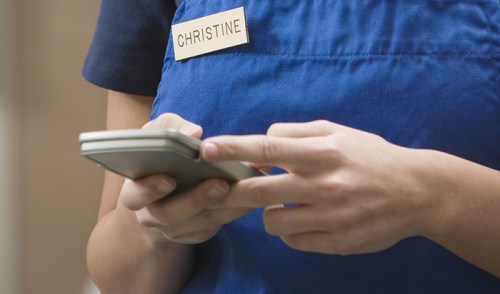
      Start with harnessing mobile technology to connect your non-desk workforce. Use a mobile messaging app as your main source of internal communication to connect the entire company via their mobile devices. Using a mobile app will enable everyone to share information, images and videos, schedule meetings and events. A mobile app will allow you to send a survey, communicate company news or announcements and send links to important documents such as benefits and open enrollment materials. A mobile app will also allow the multi-generational workforce to access the information when they want it.

      2. Digital video message boards.

      Place digital displays in high traffic areas like break rooms or near restrooms. Digital message boards can be setup wirelessly and updated instantly. Post the latest news, videos or any important company announcements.

      3. Team meetings and town hall meetings.

      Communicating in person with your non-desk employees should be a vital part of your internal communication plan. You can hand out documents, answer questions and share the latest company news. Include town hall meetings and shift meetings in your communications strategy.

      4. Printed information still works.

      Providing non-desk workers printed documents may seem outdated but they still work. Home mailers, in office posters and banners along with break rooms table tents and take-one handouts can communicate successfully when they are crafted properly.

      So remember, it’s important to include non-desk employees in all your communications to help build a successful company culture, empower and improve loyalty and ultimately improve your company’s bottom line.

      Share this: Share

      • Click to share on X (Opens in new window) X
      • Click to share on Facebook (Opens in new window) Facebook
      • Click to share on LinkedIn (Opens in new window) LinkedIn
      Like Loading...
      Posted in HR Employee Communication Tips | 0 Comments
    • 8 ways to use video to improve employee communications and engagement.

      Posted at 5:15 pm by Bill Shirk, on September 27, 2016

      8-ways-to-use-video

      Engaging employees is no easy task. People don’t want to read communications. Printed materials can be expensive and not accessible 24/7. And some traditional employee communication tactics leave employees confused and disengaged.

      That’s why it has become increasingly important for today’s businesses to adopt the use of videos into their employee communications programs.

      Videos are entertaining, engaging and reach everyone in the multi-generational workforce. With videos, you can make difficult messages easy to understand, share the company brand messaging and create a recruiting tool.

      So here are 8 ways to use video to engage your workforce and improve communications.

      Leadership Messaging. Various studies have shown that the more company leadership communicates with their employees the more connected and engaged the employees will feel. Leadership messaging can be about company or industry news, the launch of a new product or service, a client win, benefits or wellness news, a holiday message or even a state-of-the-business message.

      Benefits, Open Enrollment and Wellness Communications. Most employees become disengaged with benefits communications. They find them confusing and just too much to read. Communicating benefits with videos can be entertaining, memorable and engaging while delivering the details that will help employees to make important decisions regarding their benefits and health coverage. Create various versions of your benefits, open enrollment or wellness videos – a longer, all- inclusive version, plus shorter versions, each with specific details. Post the videos on the company Intranet, benefits microsite or on video boards so all employees may access 24/7.

      Demonstrations, Tutorials and Sales Training Tools. Videos can help improve productivity, sales, and customer satisfaction. Almost anyone can capture a live demonstration, sales training, or a one-on-one tutorial on a smartphone to post online.

      Company or Industry Events. Communicate the company’s latest news, office events or industry news through videos. Recruiting events, volunteerism events, promotions or even a company outing are a few ways to use videos to keep the employees connected and engaged.

      Associate Profile Stories. Storytelling is one of the most engaging uses for video. An employee can share his or her perspective on everything from open enrollment experiences to their advancements and career story. Turn your employees into storytellers and communications ambassadors.

      Recruiting. Every business should have a recruiting video. What better way to showcase the opportunities your company has to offer? An exciting and entertaining video does a lot more to engage and intrigue new recruits than a brochure or flyer.

      Onboarding. For new employees, this is their first exposure to internal communications. These videos can include leadership and manager welcome messages, overviews of company culture, brand values, the company’s mission statement and/or core values, company handbook polices and benefits.

      Video Conferencing. This works great for companies that have mobile employees or multiple office locations. And are much more engaging than a conference call.

      Videos captivate almost every employee across the office from Boomers to Millennials and can be the best communications tactic for nearly any subject.

      So consider adding videos to your communications strategy and improve your employee communications and engagement.

      Share this: Share

      • Click to share on X (Opens in new window) X
      • Click to share on Facebook (Opens in new window) Facebook
      • Click to share on LinkedIn (Opens in new window) LinkedIn
      Like Loading...
      Posted in HR Employee Communication Tips | 0 Comments
    • How to communicate benefits information and engage the multi-generational workforce.

      Posted at 4:40 pm by Bill Shirk, on September 7, 2016

      mulit-generational-workers

      As HR managers are well aware, today’s workforce has four distinct generations of employees. From those that are delaying their retirements, the Silent Generation, to the newest employees joining the workforce, the Millennials.

      Understanding the priorities of each generation

      Here’s a breakdown of each generation:
      The Silent Generation, born 1925 to 1945
      – The eldest group of employees
      – Prefer written communications
      – Shaped by WWII and the Great Depression
      – Uses technology
      – Slower to adapt to new things

      The Baby Boomers, born 1946 to 1964
      – Want to know the big picture
      – Like to try new things
      – Want multiple choices
      – Workaholics – they live to work
      – Spend the most on technology products
      – Use smart phones and tablets

      Generation X, born 1965 to 1980
      – Skeptical of the status quo
      – View everyone as being the same
      – Like hearing feedback
      – You must earn their respect
      – Make decisions at their own pace
      – Prefer images and graphics to written words

      The Millennials, born 1981 to 2000
      – Entrepreneurial and goals oriented
      – Multi-taskers
      – Communicate electronically
      – Like lots of feedback and constructive criticism
      – Appreciate quick-witted humor
      – Not face-to-face communicators
      – Involved into charitable giving and volunteerism
      – Available 24/7

      Each generation has a distinct communication style, from one-on-one meetings to instant messaging. So how do you communicate benefits information that will engage your entire workforce?

      With such a diverse workforce, there is no one-size-fits-all method for communicating benefits information. The most effective solution is to develop a communications plan that uses multiple communication channels.

      A multi-channel strategy allows employees to choose how to receive their information, creates more awareness of your benefits programs and ultimately helps employees make better decisions about their benefits.

      Your multi-channel benefits communication plan should include some of the following:
      – Town hall meetings
      – One-on-one meetings
      – Company intranet posts
      – In-home mailings
      – Webinars
      – Benefits micro-sites
      – Instant messaging
      – Text messaging
      – Emails
      – Video conferencing- Blogs
      – Social networks such as Facebook, LinkedIn, Instagram
      – Internet bulletin boards
      – Video presentations
      – Brochures
      – Newsletters
      – Infographics

      By acknowledging the generational differences and eliminating the communication barriers, you’ll engage your workforce to learn more about their benefits in a way that they prefer.

      Share this: Share

      • Click to share on X (Opens in new window) X
      • Click to share on Facebook (Opens in new window) Facebook
      • Click to share on LinkedIn (Opens in new window) LinkedIn
      Like Loading...
      Posted in HR Employee Communication Tips | 0 Comments
    • 4 tips for better employee communications.

      Posted at 6:50 pm by Bill Shirk, on August 25, 2016

      shutterstock_125888744

      Several studies have shown that the more informed an employee is, the happier, more productive and more loyal they become. Here are 4 things you can do to educate your workforce and make a big impact with employee communications.

      1. Town hall style meetings: gather a group and present the latest news and information. Make your presentation engaging and entertaining. Decorate the room. Encourage audience participation. Conclude with a Q&A session.
      1. Use an Intranet site, chat boards like Airbro and/or video messaging. Regularly post information from around the company on your own Intranet site. An Intranet site or chat boards allow employees to access information on their schedule either at home or at work.

      Showcase employee profiles, produce and post leadership video messages that share important, timely company news, include updates on industry news, employee surveys, as well as on benefits, open enrollment and wellness information.

      1. Regularly communicate Core Values and Brand Messaging. This helps your employees to understand their role in the company and what is expected of them. Provide the company’s point-of-view and brand messaging for employees to use when communicating with suppliers or potential employees.
      1. Communication messaging should be clear and easy to understand. According to MetLife’s 14th Annual U.S. Employee Benefit Trends Study, just 21% of employees said that their benefit information was easy to understand.

      Keep all your communications short, sweet, simple and clear.

      Share this: Share

      • Click to share on X (Opens in new window) X
      • Click to share on Facebook (Opens in new window) Facebook
      • Click to share on LinkedIn (Opens in new window) LinkedIn
      Like Loading...
      Posted in HR Employee Communication Tips | 0 Comments
    • Recent Posts

      • Why employee engagement is crucial to a company’s success?
      • 3 tips to help your internal communications connect and engage with the multi-generational workforce.
      • Why leadership messaging should be a crucial employee engagement tool in your internal communications plan.
      • Why employee profile stories should be part of your next communications program.
      • 4 things you can do to connect and engage the non-desk workforce.
    • Archives

      • April 2017
      • January 2017
      • November 2016
      • October 2016
      • September 2016
      • August 2016
    • Comments

    • The Author

      Unknown's avatar

      When he’s not creating employee engagement programs or blogging on brain-xchange, Bill likes to golf, garden, and play fetch with his cat, Pepper. His all-time favorite pastime: ice cream.

    • Enter your email address to follow this blog and receive notifications of new posts by email.

  • Recent Posts

    • Why employee engagement is crucial to a company’s success? April 5, 2017
    • 3 tips to help your internal communications connect and engage with the multi-generational workforce. January 9, 2017
    • Why leadership messaging should be a crucial employee engagement tool in your internal communications plan. November 15, 2016
    • Why employee profile stories should be part of your next communications program. October 25, 2016
    • 4 things you can do to connect and engage the non-desk workforce. October 14, 2016
  • Comments

  • Archives

    • April 2017
    • January 2017
    • November 2016
    • October 2016
    • September 2016
    • August 2016
  • Contact

    1-678-473-9055

Blog at WordPress.com.

  • Subscribe Subscribed
    • BrainXchange
    • Already have a WordPress.com account? Log in now.
    • BrainXchange
    • Subscribe Subscribed
    • Sign up
    • Log in
    • Report this content
    • View site in Reader
    • Manage subscriptions
    • Collapse this bar
 

Loading Comments...
 

    %d